How Unprocessed Emotions Show Up in Everyday Life

Most people do not walk around thinking, “I have unprocessed emotions.”
What they notice instead is:
the exhaustion that never fully goes away,
the overthinking at night,
the short temper during small conversations,
the emotional shutdown after stressful days,
or the feeling of always being “on edge” without knowing why.
For many high-functioning adults, unprocessed emotions do not look dramatic from the outside. Life continues. Work gets done. Responsibilities are handled.
But internally, the nervous system may still be carrying emotional experiences that were never fully processed, expressed, or regulated.
This is where emotional patterns begin to quietly shape everyday life.
Many people seek EFT healing or EFT tapping not because they are “falling apart,” but because they are tired of carrying emotional stress that keeps repeating in different forms.
Understanding how unprocessed emotions show up can help people move from self-judgment toward awareness, emotional regulation, and healing.
What Are Unprocessed Emotions?
Unprocessed emotions are emotional experiences that were never fully felt, understood, expressed, or safely released.
This does not only happen after major trauma.
It can happen after:
Chronic stress
Emotional neglect
Repeated criticism
Burnout
Relationship conflict
High-pressure environments
Grief that had no space
Childhood experiences where emotions felt unsafe
Long periods of survival mode
Sometimes people suppress emotions because they had to function.
They learned:
“Stay strong.”
“Don’t overreact.”
“Keep moving.”
“Other people have it worse.”
“I don’t have time to deal with this.”
Over time, the nervous system adapts around emotional suppression. The body stays alert. The mind stays busy. Emotional tension becomes normalized.
This is why many emotionally aware adults struggle to identify what they are actually feeling. They may be highly intelligent, capable, and self-aware — but emotionally disconnected from themselves.
Not because something is wrong with them.
Because the nervous system learned protection before regulation.
The Nervous System Remembers What the Mind Tries to Ignore
One of the most misunderstood aspects of emotional health is that emotions are not only “mental.”
They are physiological experiences.
Stress, fear, shame, anger, disappointment, grief, and overwhelm all create responses within the nervous system and body.
When emotions are not processed, the body often continues carrying the stress response long after the original situation has passed.
This can show up as:
Chronic tension
Restlessness
Emotional numbness
Hypervigilance
Difficulty relaxing
Fatigue with mental overactivity
Feeling emotionally reactive without understanding why
Someone may logically know they are safe now, yet their nervous system still behaves as though danger is present.
This is one reason emotional regulation matters so deeply.
Healing is not only about “thinking positively.” It is also about helping the nervous system feel safer enough to stop remaining in constant survival mode.
Practices like EFT tapping are often used because they combine emotional awareness with body-based regulation. Rather than avoiding emotions, people gradually learn how to experience emotional activation with more safety and less overwhelm.
Unprocessed Emotions Often Appear as Everyday Patterns
Many emotional patterns are misunderstood as personality flaws.
In reality, they can be protective adaptations.
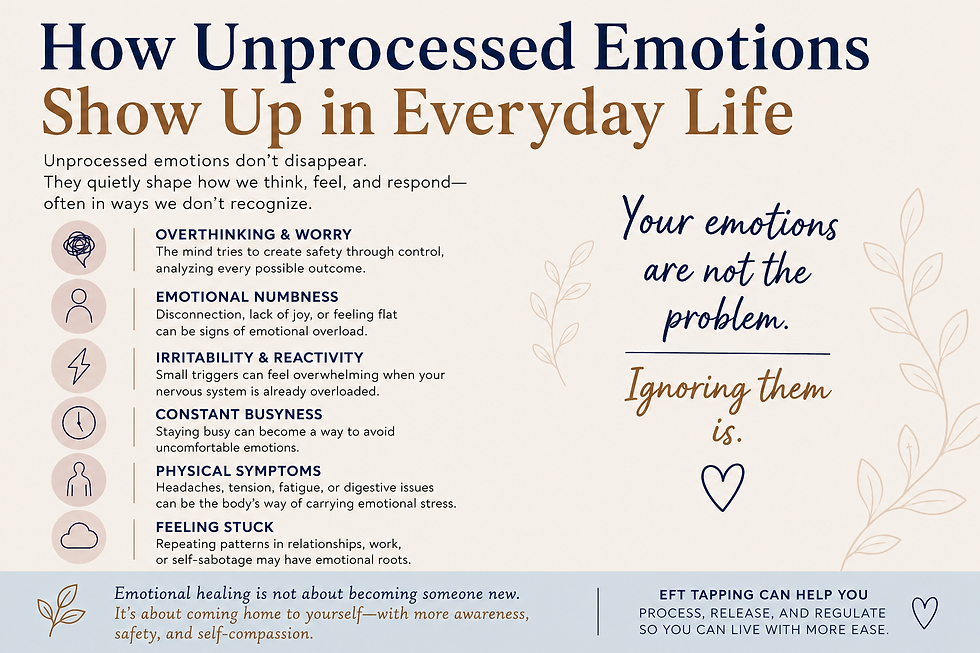
Overthinking Everything
Overthinking is often an attempt to create safety through control.
The mind keeps analyzing:
conversations,
decisions,
future scenarios,
possible mistakes,
worst-case outcomes.
For many professionals, overthinking becomes normalized because it is rewarded as productivity or responsibility.
But underneath excessive mental activity, there is often anxiety, fear of failure, fear of rejection, or unresolved emotional stress.
The nervous system stays activated, and the brain keeps searching for certainty.
The problem is that emotional stress cannot always be solved intellectually.
This is why many people say:“I understand my patterns logically, but I still feel stuck emotionally.”
Emotional Numbness and Disconnection
Not all unprocessed emotions create visible emotional intensity.
Sometimes they create the opposite.
People may feel emotionally flat, disconnected, or detached from themselves.
They continue functioning but struggle to feel:
joy,
excitement,
motivation,
connection,
emotional presence.
This often happens after long periods of chronic stress or emotional suppression.
The nervous system may reduce emotional responsiveness as a form of protection.
People sometimes judge themselves harshly for this:
“Why can’t I feel anything?”
“Why am I emotionally unavailable?”
“Why do I feel distant even from people I care about?”
In many cases, numbness is not absence of emotion.
It is emotional overload that was never safely processed.
Irritability Over Small Things
Unprocessed emotions do not always emerge as sadness.
Often they show up as irritation.
A small inconvenience triggers a disproportionately large emotional reaction:
traffic,
emails,
interruptions,
criticism,
noise,
delays,
feeling ignored.
When the nervous system is already carrying accumulated stress, even small triggers can feel overwhelming.
People often blame themselves for being “too sensitive” or “too reactive.”
But emotional reactivity is frequently a sign that the nervous system has been overloaded for too long without recovery.
This is especially common in high-functioning individuals who spend most of their time managing pressure while ignoring emotional exhaustion.
Constant Busyness Can Become Emotional Avoidance
Many people stay busy because slowing down feels uncomfortable.
The moment silence appears, unresolved emotions surface.
So the schedule stays full:
work,
productivity,
scrolling,
multitasking,
constant stimulation.
From the outside, this can look ambitious or disciplined.
Internally, it may be a nervous system trying to avoid emotional discomfort.
Busyness itself is not the problem.
The problem begins when a person no longer knows how to feel safe without distraction.
This is one reason emotional healing often feels unfamiliar at first. Stillness can initially feel more uncomfortable than stress because the body has adapted to constant activation.
Physical Symptoms Without Clear Medical Causes
Emotional stress can also show up physically.
This does not mean symptoms are “imaginary.”
The nervous system and body are deeply connected.
Unprocessed emotional tension may contribute to:
headaches,
digestive discomfort,
jaw tension,
fatigue,
sleep difficulties,
muscle tightness,
shallow breathing,
nervous system dysregulation.
Of course, medical evaluation is important when symptoms are persistent or concerning.
But many people notice that physical symptoms intensify during emotional stress, conflict, overwhelm, or burnout.
The body often communicates what the mind has not fully acknowledged.
Why Emotional Awareness Alone Is Sometimes Not Enough
Many emotionally intelligent people already know their patterns.
They have read the books.Listened to the podcasts.Done the journaling.Understood the psychology.
Yet the emotional response still happens automatically.
Why?
Because insight and nervous system regulation are not always the same thing.
Understanding an emotional wound intellectually does not automatically teach the body how to feel safe.
This is where body-based approaches like EFT healing can become supportive.
EFT tapping combines cognitive awareness with gentle somatic regulation through tapping on acupressure points while acknowledging emotional experiences.
Some people find that this process helps reduce emotional intensity, improve emotional regulation, and create more space between triggers and reactions.
Not because emotions disappear instantly, but because the nervous system gradually becomes less overwhelmed by them.
Emotional Healing Does Not Mean Becoming Emotionless
A common misconception is that healing means never feeling anxious, triggered, emotional, or stressed again.
That is not realistic.
Emotional healing is often less about eliminating emotions and more about changing the relationship with them.
People may begin noticing:
faster recovery after stress,
less emotional shutdown,
fewer spirals,
more self-awareness,
reduced emotional overwhelm,
improved nervous system regulation,
greater emotional safety within themselves.
Healing often looks subtle before it looks dramatic.
Sometimes progress is:
pausing before reacting,
recognizing emotional triggers earlier,
setting healthier boundaries,
allowing emotions without shame,
feeling calmer in situations that once felt overwhelming.
These changes may appear small externally, but internally they can represent major nervous system shifts.
Real-Life Example: The High-Functioning Professional
Consider someone who appears highly successful.
They meet deadlines, manage responsibilities, and seem calm under pressure.
But internally:
they cannot relax,
they constantly anticipate problems,
criticism feels deeply threatening,
rest creates guilt,
relationships feel emotionally difficult,
sleep never feels restorative.
Eventually they begin asking:
“Why do I feel exhausted all the time?”
“Why am I always anxious even when things are fine?”
“Why do small things affect me so much?”
Often the issue is not lack of capability.
It is accumulated emotional stress that was adapted to rather than processed.
This is why emotional healing work is not only for crisis situations.
Sometimes it is for people who have spent years functioning while emotionally overwhelmed underneath.
How EFT Tapping Can Support Emotional Regulation
EFT tapping is not about forcing positivity or pretending difficult emotions do not exist.
It encourages acknowledging emotional experiences while helping regulate the nervous system simultaneously.
Many people appreciate EFT because it feels practical, grounded, and emotionally approachable.
Sessions may help people:
identify emotional patterns,
process emotional stress safely,
reduce nervous system activation,
improve emotional awareness,
build emotional resilience,
create healthier responses to triggers.
For individuals who feel emotionally stuck despite intellectual understanding, this combination of emotional processing and nervous system support can feel different from purely cognitive approaches.
Healing usually happens gradually.
Not through perfection.Not through emotional suppression.And not through forcing oneself to “move on” before the body is ready.
Closing: Emotional Patterns Are Often Signals, Not Failures
Many people spend years criticizing themselves for emotional patterns that actually developed as forms of protection.
The anxiety.The overthinking.The emotional shutdown.The irritability.The constant tension.
These patterns are not always signs of weakness.
Often they are signs that the nervous system has been carrying too much for too long without enough support, safety, or emotional processing.
Awareness is not about blaming the past or becoming consumed by emotions.
It is about understanding yourself with more honesty and less shame.
Healing can begin when people stop asking,“What is wrong with me?”and start asking,“What has my nervous system been trying to manage all this time?”
Sometimes emotional healing is not about becoming a completely different person.
Sometimes it is about finally feeling safer being yourself.


Comments